
Future of Image Optimization in Web Development: Trends, Formats, and Performance in 2026

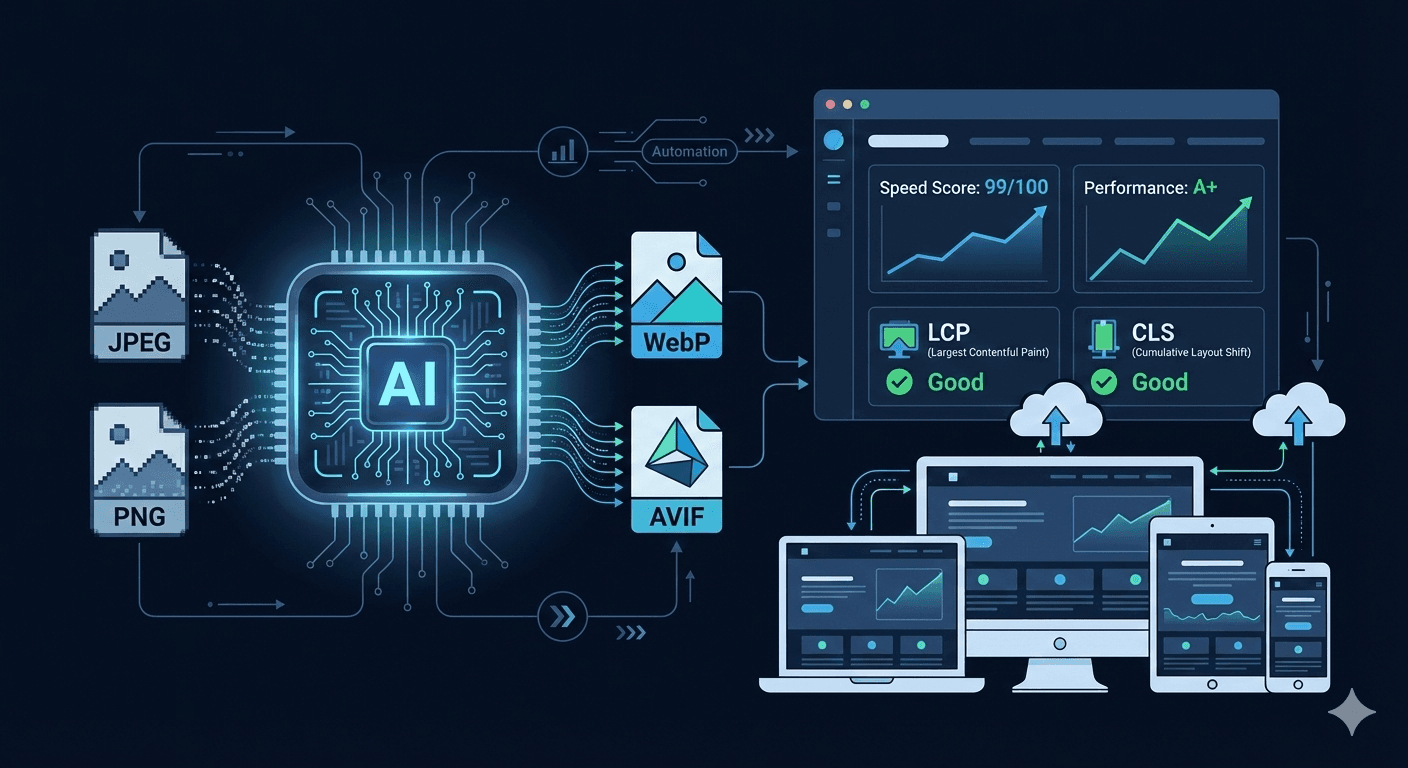
The State of Image Optimisation in 2026: Formats, Trends, and What Comes Next
When this guide was first published in January 2026, WebP was already the baseline and AVIF was on the cusp of full browser parity. Three months later, the landscape has clarified. Some predictions have landed; others have not. This updated version covers where image optimisation actually stands in March 2026 — what is production-ready, what is still maturing, and what the next 12–24 months will realistically bring.
Where Image Optimisation Stands Right Now
The fundamentals that were "best practice" in 2024 are now table stakes. WebP is universally supported and should be the minimum output format for any web-delivered image. AVIF has reached approximately 93–95% browser coverage across Chrome, Edge, Firefox, and Safari, making the AVIF-first, WebP-fallback <picture> stack practical for production deployment without meaningful compatibility risk.
Core Web Vitals remain confirmed Google ranking signals, and the passing thresholds — LCP under 2.5 seconds, CLS under 0.1, INP under 200 ms — have not changed. What has changed is that the percentage of sites failing LCP due to unoptimised hero images has remained stubbornly high despite years of tooling improvements. The problem is not knowledge — it is pipeline consistency. Sites that compress images before upload, deliver WebP/AVIF via <picture>, set width and height on every image, and apply fetchpriority="high" to the LCP element consistently pass CWV. Sites that do not, do not. The complete Core Web Vitals guide covers every attribute and threshold with code examples.
Images still represent more than 50% of total page weight on the median webpage. Despite format improvements, the volume of images per page has increased alongside higher design expectations and richer visual content. Compression gains from format conversion are real and substantial — but they are offset at the site level by growth in image count per page. The net effect is that total image payload has not decreased industry-wide despite years of WebP adoption. Per-image optimisation matters; so does deciding how many images a page actually needs.
The Format Landscape in 2026
WebP: The Established Baseline
WebP is no longer a "modern format" — it is the baseline. Universal browser support since 2021, broad CDN and CMS tooling support, and a well-understood quality curve at quality 78–85 for photographic content. Any new web project that is not delivering WebP by default has an unresolved gap in its image pipeline. For the detailed technical comparison covering compression ratios, lossless vs lossy modes, and when WebP is sufficient vs when AVIF is worth the added complexity, the AVIF vs WebP guide covers both formats with build pipeline context.
AVIF: Production-Ready, Pipeline-Constrained
AVIF is production-ready in 2026. The remaining barrier is not browser support — it is encode time. AVIF encodes take 5–20× longer than WebP at equivalent quality settings, which creates real friction in build pipelines processing large image libraries. CDN-based format negotiation (Cloudflare Images, Cloudinary f_auto, Imgix auto=format) resolves this for delivery; manual pre-upload conversion via browser-based tools resolves it for content workflows. The pipeline question — not the format question — is what determines whether a team ships AVIF in practice.
The web performance optimisation guide covers the build pipeline configurations for Next.js, Vite, Sharp, and CDN format negotiation in detail.
JPEG XL: The Format That Did Not Ship
JPEG XL (JXL) deserves specific mention because it was discussed extensively as a next-generation format in 2021–2023 and then did not materialise as a web standard. Google removed JXL support from Chrome in 2022 (Chrome 110), citing insufficient evidence of ecosystem benefit over AVIF and WebP. As of early 2026, Chrome and Firefox have no active plans to add JXL support. Safari added JXL in Safari 17 (2023), but single-browser support is not sufficient for web deployment.
For practical web image delivery in 2026, JPEG XL is not a viable format. AVIF is the correct next step beyond WebP for teams ready to add a compression-optimised format to their pipeline.
HEIC/HEIF: Input Format, Not Output Format
HEIC (the container format for HEIF images) is the default capture format on iPhone and many Android cameras since 2022. This creates a common workflow problem: users upload HEIC files to CMSs that do not process them correctly, producing broken images or unexpected format fallbacks.
HEIC is not a web delivery format — no major browser renders HEIC natively. It is an input format that should be converted to WebP or AVIF on ingest. CMS image processing pipelines and CDN format negotiation services handle this conversion automatically. For manual conversion workflows, browser-based HEIC-to-JPG or HEIC-to-WebP conversion handles individual files before upload. The practical implication for content teams: establish a clear HEIC conversion step at the point of ingest rather than discovering broken images in production.
Where AI Compression Actually Stands
AI-assisted image compression is real but narrower in scope than its marketing suggests. Understanding the distinction between what is deployed and what is speculative matters for planning.
What is deployed and working today:
-
Perceptual quality models in encoders like
libavifandlibwebpuse machine-learning-informed models to identify regions of an image where compression artefacts are less perceptible (smooth gradients, defocused backgrounds) and allocate more bits to regions where artefacts are noticeable (sharp edges, text, faces). This is not new — it has been part of encoder design for several years — but modern encoders do it significantly better than their predecessors. -
CDN perceptual quality optimisation: Cloudinary's
q_autoand Imgix's automatic quality selection use perceptual models to choose quality settings per image based on content analysis. These produce consistently better results than a fixed quality setting applied uniformly. -
Content-aware resizing: Seam carving and similar algorithms allow images to be cropped or resized with content awareness — preserving faces, products, or focal points that a simple centred crop would lose.
What remains speculative or immature:
-
Real-time connection-speed-aware compression: adapting image quality dynamically based on measured network speed at request time is technically possible via CDN edge logic but not widely deployed in a way that produces consistent per-image quality outcomes.
-
AI image generation as a replacement for photography: useful for illustration and conceptual visuals; not yet a reliable substitute for original product photography or E-E-A-T-supporting imagery, as discussed in the AI-ready image optimisation guide.
For the broader question of where AI tools fit in the image optimisation workflow — and what they cannot currently replace — the will AI replace image optimisation tools article covers the current state in detail.
Browser-Native Capabilities That Are Live in 2026
Several browser-level image handling features have matured and are now deployable without polyfills:
loading="lazy" — fully supported across all major browsers since 2020. Defer all below-fold images. Never apply to above-fold or LCP images. The lazy loading guide covers the correct implementation pattern including the fetchpriority and decoding attribute combinations.
fetchpriority="high" — supported in Chrome, Edge, and Safari. The single most impactful attribute for improving LCP on image-heavy pages — signals to the browser to fetch the LCP image at highest priority before other resources.
CSS image-set() — the CSS equivalent of srcset for background images. Allows serving WebP or AVIF as CSS background images with a fallback:
.hero {
  background-image: image-set(
    url("hero.avif") type("image/avif"),
    url("hero.webp") type("image/webp"),
    url("hero.jpg") type("image/jpeg")
  );
}
Support: Chrome 113+, Safari 17.2+, Firefox 89+ (with prefix in older versions). Broad enough for production use with a solid JPG fallback.
WebCodecs API — a low-level browser API giving JavaScript direct access to video and image encoding/decoding. Enables browser-based applications to encode to WebP and AVIF locally without server round-trips. This is the API that powers the next generation of browser-based image tools — including what MeloTools uses for in-browser AVIF conversion. As WebCodecs support matures, client-side image format conversion becomes increasingly capable without requiring native app installs or server infrastructure.
Client Hints (Accept-CH: DPR, Viewport-Width) — allows servers and CDNs to receive device pixel ratio and viewport width information via HTTP headers, enabling server-side responsive image selection without srcset in HTML. Limited to HTTPS and requires opt-in. Useful for CDN-based image delivery but not a replacement for HTML-level responsive images in most configurations.
What Remains Constant Regardless of Format Changes
The following practices are not affected by format evolution — they applied in 2020, apply now, and will apply in 2028:
Resize before compressing. A 4000px image resized to 800px before WebP conversion produces a file roughly 90% smaller than a 4000px WebP at the same quality setting. Resizing removes more data than any format improvement.
Set width and height on every image. Missing dimensions cause CLS. CLS is a ranking signal. This has been true for five years and has not changed.
Descriptive filenames and alt text. running-shoe-red-lateral-view.webp with alt text "Red running shoe lateral view showing heel cushioning" outperforms img_0847.webp with alt text "shoe" in both image search and AI-powered search interpretation. The complete guide to image optimisation and SEO signals covers the full ranking mechanism.
Compress before upload. Every unoptimised image uploaded to a CMS is a performance debt that compounds across every page view until the asset is manually replaced. The full image format toolkit covers the available tooling for each workflow type.
The Next 12–24 Months
Based on what is in active browser development and standards processes as of early 2026:
AVIF encode speed improvements: The libaom encoder (the reference AVIF encoder) continues to improve encode speed per quality point. Expect AVIF encode time to drop meaningfully in Sharp and CDN pipelines over 2026–2027, reducing the pipeline friction that currently makes some teams default to WebP-only.
CSS image-set() full cross-browser parity: The remaining prefixed/partial implementations should reach full parity across Chrome, Firefox, and Safari in 2026, making it reliable for production CSS background image delivery.
WebCodecs expansion: As WebCodecs matures, expect more sophisticated browser-based image processing capabilities — batch conversion, responsive variant generation, and perceptual quality analysis — without requiring server infrastructure.
<img> fetchpriority in Firefox: Chrome and Safari support fetchpriority; Firefox has the feature behind a flag as of early 2026. Full cross-browser support will improve LCP across all visitors, not just Chrome/Safari users.
HEIC CMS handling: As HEIC uploads become the default from mobile devices, expect CMS platforms to add native HEIC ingest and conversion, reducing the workflow gap for content teams managing mobile-originated photography.
Practical Checklist: Current-State Optimisation in 2026
| Task | Status |
|---|---|
| Deliver WebP as minimum output format | ✅ Baseline — deploy now if not done |
Add AVIF as primary with WebP fallback via <picture> | ✅ Production-ready |
Set fetchpriority="high" on LCP image | ✅ Deploy now — Chrome + Safari |
Apply loading="lazy" to all below-fold images | ✅ Universal browser support |
Set width and height on every <img> | ✅ Non-negotiable |
Use image-set() for CSS background images | ✅ Broad support — use with JPG fallback |
| Convert HEIC uploads on ingest | ✅ Via CDN transform or manual workflow |
| JPEG XL deployment | ❌ Not viable — Chrome/Firefox no support |
| AI real-time quality adaptation | ⚠️ CDN perceptual quality (Cloudinary q_auto) is real; per-request network-aware compression is not reliably deployed |
Frequently Asked Questions
Is JPEG XL worth implementing in 2026?
No. Chrome and Firefox do not support JPEG XL and have no active plans to add it. Safari 17+ supports it, but single-browser format support is not sufficient for production web deployment. AVIF is the correct next-generation format for teams ready to move beyond WebP.
How much does switching from WebP to AVIF actually improve performance?
At equivalent visual quality, AVIF produces files approximately 20–50% smaller than WebP depending on image content. For a 280 KB WebP hero image, an AVIF equivalent is typically 160–200 KB — a reduction that produces a measurable LCP improvement on mobile connections. The gain is larger for complex photographic content than for flat-colour graphics.
Will AI compression replace manual optimisation workflows?
Not in the near term. AI-assisted perceptual quality models are already embedded in modern encoders and CDN quality optimisation. They improve results at a given quality setting. They do not eliminate the decisions about format, dimensions, lazy loading, or structured data that determine overall image delivery quality. See the AI vs image optimisation tools guide for the full picture.
What is the most impactful single image optimisation change for most sites?
Adding fetchpriority="high" to the LCP image, combined with compressing that image to WebP or AVIF at quality 80–85. Together these two changes address the most common cause of Poor LCP scores — a large, unoptimised hero image that the browser loads at default priority.
Summary
Image optimisation in 2026 is no longer a future roadmap item — the formats (WebP, AVIF), the browser APIs (fetchpriority, loading, decoding, image-set()), and the pipeline tooling (Next.js Image, Sharp, CDN format negotiation) are all production-ready. The remaining gap is implementation consistency: teams that have a systematic pipeline deliver consistently optimised images; teams that rely on manual per-upload decisions do not. JPEG XL did not become a web format. AVIF did. AI compression has improved encoder quality algorithms meaningfully but has not eliminated the fundamental workflow decisions. The next 12–24 months will bring incremental improvements to encode speed, CSS format delivery, and browser API parity — not a format revolution. MeloTools supports the current-state workflow — WebP and AVIF conversion in the browser, no uploads, no storage — across every format that is actually production-ready today.